Loyalty & Rewards
How to Design a Shopify Points Program That Doesn’t Destroy Your Margin
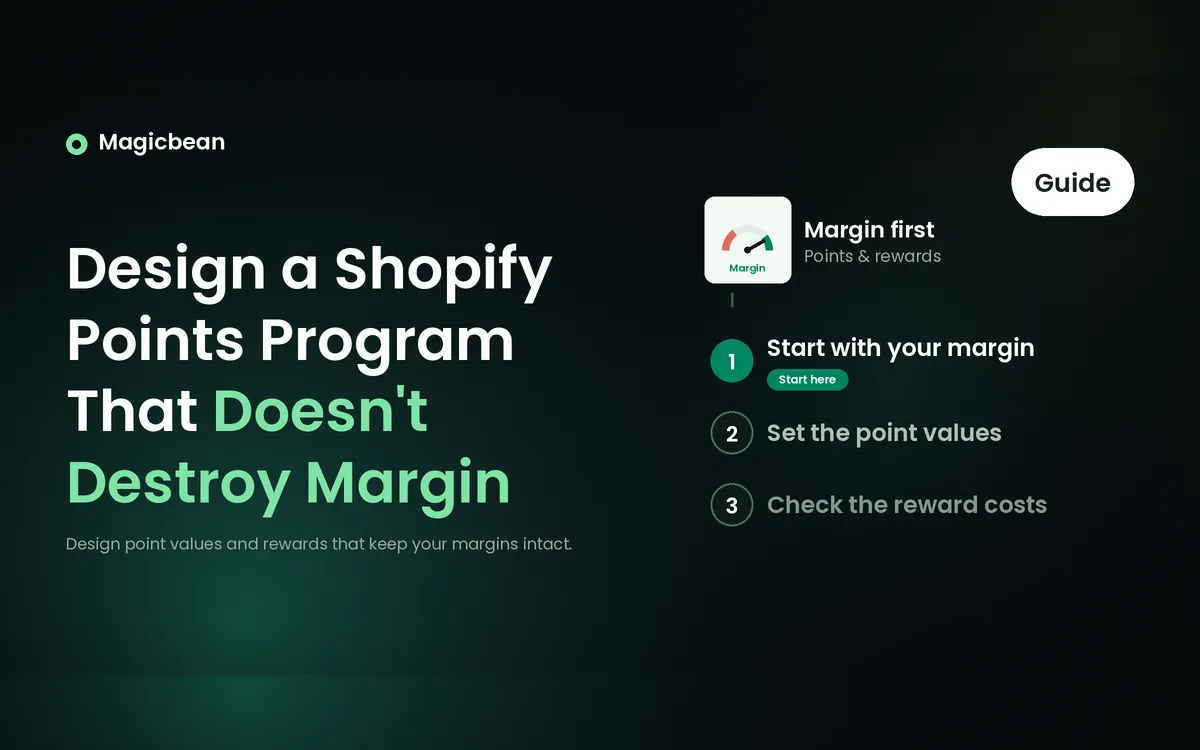
Five percent back in points sounds cheap until you check it against gross profit. On a $100 order at a 40% gross margin, a $5 reward is 12.5% of the $40 you made, and it lands before ad spend, payment fees, free shipping and the loyalty app’s own bill. That gap between revenue math and gross-profit math is where most loyalty program profit margin disappears.
Operators on r/shopify describe the result in threads from July 2025 and December 2025. Points go to regulars who would have reordered anyway, so margin drops and buying behavior stays the same.
The fix takes four steps. Price rewards against gross margin, keep the first reward out of reach until a second order, close seven Shopify and app settings that leak discounts, then audit the program after 90 days. If you haven’t launched yet, start with how to create a loyalty program on Shopify and come back here before you set reward values.
Key Summary
- Set your effective reward rate at about one tenth of your gross margin percentage. A 50% margin store gives about 5% back. Then test that rate assuming every point gets redeemed.
- Free-product rewards cost a fraction of an equal cash coupon, but only when the reward needs a paid item in the cart.
- This setup doesn’t suit a store that hasn’t worked out gross margin by product yet. Do that first, or the numbers below rest on a guess.
Step 1: Set your loyalty program profit margin budget in gross margin terms
A reward’s real cost depends on three numbers. They are how much you give back, how much of it gets used, and what each redeemed dollar costs you in product or cash.
The 3-line loyalty margin formula
- Effective reward rate: reward value ÷ spend needed to earn it. A $5 reward after $100 of spend is 5%.
- Real program cost (% of revenue): effective reward rate × redemption rate × reward cost factor.
- Share of gross profit given up: real program cost ÷ gross margin %.
The cost factor is 1.0 for a cash discount, COGS ÷ retail price for a free product, and close to zero for perks such as early access. Once you know the rate, turning it into points per dollar is a separate presentation choice, covered in how many loyalty points customers should earn per dollar.
Find your store’s reward ceiling
Start from fully loaded gross margin, which is (net sales − product COGS − inbound freight − packaging and pick-pack − payment processing) ÷ net sales.
Then decide what share of gross profit you’ll reinvest in repeat orders. Ten percent leaves 90% of gross profit for overhead and shipping thresholds. Multiply the two and you have your ceiling for cash-value rewards.
| Fully loaded gross margin | Ceiling at 10% of gross profit | Typical stores | Working range for cash rewards |
|---|---|---|---|
| 30% | 3.0% | Multi-brand retail, electronics, food and drink | 1–3% |
| 50% | 5.0% | Apparel, footwear, home goods | 3–5% |
| 70% | 7.0% | Skincare, cosmetics, supplements | 5–8% |
The vendors land in the same range. Smile’s help center suggests 3–10% back in points value, and LoyaltyLion’s recommends no more than 5%. The table tells you where your own store sits inside that spread.
Model redemption at 100%
Pull points issued and points spent from your app’s export. Redemption rate is points spent ÷ points issued, and breakage is the remainder. Smile reports that the average loyalty program has a 13.67% redemption rate, and it suggests waiting six months before judging yours.
That average looks low because one-time buyers collect signup and first-order points and never return. Your repeat customers redeem far closer to 100%, and they’re the ones the program is built for. So test every reward at 100% redemption first and treat breakage as a buffer you didn’t plan to spend.
Worked example: cash discounts cost about 3x more than free products
Take a store with a 65% gross margin, so a $100 order carries $65 of gross profit. Each reward below is worth $10 to the shopper and is redeemed in full.
| Reward | Cost factor | Your cost | % of revenue | % of gross profit |
|---|---|---|---|---|
| $10 discount code | 1.0 | $10.00 | 10.0% | 15.4% |
| $10 retail free product ($3.50 COGS) | 0.35 | $3.50 | 3.5% | 5.4% |
| Early access to a new drop | ≈ 0 | ≈ $0 | ≈ 0% | ≈ 0% |
The shopper gets the same $10 of value from the first two rows. The free product costs 2.9 times less. Perks like early access or member-only restocks cost almost nothing and work best as tier benefits, as several of these Shopify loyalty program examples show.
Step 2: Gate your first redemption behind a second order
Free points that add up to a reward turn your first order into a coupon order. A merchant on r/shopify described the pattern in March 2026, with plenty of signups and almost no repeat purchases.
Here’s how it happens. Account creation pays 150 points, a birthday 100 and an Instagram follow 100. That’s 350 points, and the smallest reward costs 300. A deal hunter signs up, claims $5 off order one on top of what you paid to acquire them, and never comes back. If those small codes can be combined, Smile’s own documentation warns that customers can farm non-purchase points into several discounts and stack them at checkout.
Smile’s program setup guide sets three rules worth copying.
- Make the first reward reachable after about 1 to 3 purchases.
- Require at least one purchase before any redemption.
- Keep points from signup and social actions below your lowest reward.
We’d go one step tighter and cap all free points at 35–50% of the first reward. Say you award 5 points per $1 and your first reward is $5 for 500 points. Three social follows at 50 points each make 150, and a signup bonus of 100 to 150 brings free points to 250 to 300. The shopper still has to spend $40 to $50 on order one before the coupon unlocks for order two.
If you want something to show new members on day one, use a tier perk that costs nothing to give. Free early access or a members-only restock alert fills that gap, and these Shopify loyalty apps with VIP tiers and points expiry all support perks of that kind.
Step 3: Close the 7 settings where loyalty program margin leaks
A well-priced reward still loses money if it stacks with a sale code, earns on a return or lives forever. These seven settings close the gaps. Admin paths come from each vendor’s help center as of October 2026.
1. Block discount stacking, including the POS and gift-card loopholes
Shopify applies two discounts together only when the setting on each discount allows it. Keep loyalty rewards uncombinable with order-level promos such as welcome pop-ups and Black Friday sales.
Two defaults catch merchants out.
- POS codes on Smile: online codes can’t be combined by default, but POS discount codes are combinable by default. Turn that off in Program > Points > Ways to redeem > Edit > Combinations, one reward at a time. The change applies only to codes generated after you save.
- Gift-card rewards: Shopify treats a gift card as a payment method, so a gift-card reward stacks on top of a 30%-off code even with combinations switched off. Use discount-code rewards during big sales.
The apps also differ on earning. LoyaltyLion awards no points on an order paid with a gift card. Smile counts gift cards and store credit as payment, so they stay in the rewardable total. Our Smile.io review and LoyaltyLion review cover the rest of each app’s reward settings.
2. Award points on post-discount subtotals and exclude low-margin buyers
In Smile, turn on Exclude coupon discounts used in your order settings. A customer with a $10 code on a $100 cart then earns on $90. Smile also processes Shopify B2B orders the same way as DTC orders, so wholesale buyers earn points unless you exclude them.
Love Loyalty handles both exclusions from the loyalty program screen. You can exclude collections such as Sale and Clearance from the Place an order rule. You can also exclude customer tags like B2B or Wholesale under Loyalty Program > Exclude customers. Tagged customers can’t earn or redeem while the tag stays on, and they don’t move up VIP tiers. Our Love Loyalty review covers its plans and setup.
3. Set a minimum spend, a cart floor and discount caps
A redeemed reward on a small cart can cost more than the order makes once shipping lands. Work out a break-even floor with this formula.
- Minimum cart spend = reward value + (pick-pack and shipping cost ÷ gross margin %). A $10 reward with $6 shipping at a 50% margin needs a $22 minimum.
You can also test a minimum near 1.2 to 1.5 times your 90-day AOV to lift basket size. LoyaltyLion advises against conditions on earned vouchers because customers have already paid for them. It reserves minimum spend for referral and birthday rewards. Use the break-even floor on everything and keep the AOV test for gift rewards.
- Cart floor: LoyaltyLion’s redeem-at-checkout reward lets you set a floor the cart must stay above after points apply. It needs Shopify Plus on checkout extensibility and the Classic plan or higher.
- Discount caps: Joy sets a maximum points per redemption, a maximum discount percentage of the cart and a dollar cap on percentage rewards. See our Joy Loyalty review for plan details.
- Smile limits: a percentage-off reward can’t be capped in dollars, so use fixed-amount rewards. Online, a free-product reward’s minimum checks only the free item’s price.
- Free products: LoyaltyLion’s seamless free product needs one paid item by default. Rivo’s free product reward has a minimum cart setting and an option to apply only to full-price items.
4. Stop double-discounting subscription renewals
A subscriber already on 10–20% Subscribe and Save who applies a loyalty coupon to every renewal cuts that margin again each month. Smile’s subscription settings let a reward apply to one-time purchases, subscriptions or both. For subscriptions you choose first payment only, a set number of payments or every payment, from the Standard plan up. Rivo’s free product reward has a matching purchase type setting.
Set points coupons to one-time purchases or first payment only. Reward subscribers with a fixed low-cost gift at a milestone, such as a free sample on the third renewal.
5. Delay points approval past your return window
Without a pending period, a shopper buys $300 of clothes, spends the points on a second order and returns the first. LoyaltyLion recommends matching the approval period to your returns period. If points are spent before a return, LoyaltyLion still deducts them and the balance goes negative.
Check how refunds reach the app. Smile cancels points when an order hits a refund status you pick under Settings > Platform > Order Settings, and it deducts points in proportion on partial refunds. But returns issued as store credit don’t cancel points until someone marks the order Refunded. If your return portal issues store credit, add that step to the returns checklist.
6. Cap liability with points expiry and reward expiry
There are two clocks. Points expiry clears unspent balances. Reward expiry clears vouchers a customer has claimed and not used.
- Points expiry methods: LoyaltyLion offers last purchase, last points balance change, date earned and calendar date. On last points balance change, automatic birthday points count as activity and keep old balances alive. Rivo offers per-event (first in, first out) and bulk expiry.
- Reward expiry: LoyaltyLion’s reward expiration runs from 7 days to 2 years, with 6 months marked as recommended. It isn’t retroactive, and points spent on a reward that expires aren’t returned.
Expiry also sits on different plans in each app. Check this before you pick a tier.
| App | Points expiry from | Price (monthly) | Source |
|---|---|---|---|
| Love Loyalty | Professional | $12 | Pricing sheet, Sep 2026 |
| Rivo | Scale | $49 | Shopify App Store listing, Oct 2026 |
| Smile | Growth | $199 | smile.io pricing, Sep 2026 |
| LoyaltyLion | Classic (points and reward expiry) | From $199 | LoyaltyLion help center, Oct 2026 |
Our Shopify loyalty app pricing comparison shows what each plan costs at higher member counts.
7. Count the app’s fees and overage inside your program margin
Most apps bill on all monthly store orders, member or not. Here’s what three plans cost at 3,000 orders a month.
| Plan | Included orders | Overage | Cost at 3,000 orders |
|---|---|---|---|
| Love Loyalty Growth ($79) | 2,000 | $15 per 100 | $229 |
| Smile Growth ($199) | 2,500 | $20 per 100 | $299 |
| Rivo Scale ($49) | 400 | $20 per 100, capped at $499 | $499 |
Plan limits come up often when merchants are unhappy. In Magicbean’s review study of 25 Shopify loyalty apps, 25% of pricing complaints were about features behind a higher plan or order limits. The study’s second pre-purchase check is to read the pricing page past the headline number, including order caps and what triggers an upgrade. Love Loyalty drew 14 pricing mentions with 1 complaint across 186 written reviews.
Subtract the monthly fee and overage from the program’s incremental gross profit before you call it profitable. The real cost of Shopify loyalty apps at scale breaks down order limits and feature gates across apps.
Step 4: Audit your loyalty program profit margin after 90 days
Your app’s loyalty revenue card isn’t a margin report. If a regular customer was already checking out and clicked the points slider, the app counts that whole order as loyalty-influenced. Check three numbers each quarter.
- Blended discount rate. Add total discounts to free-product COGS and shipping subsidies, then divide by gross sales. Compare it with the quarter before launch. If points stacked on top of your existing 15–20% promo calendar, this rate climbs. MetricUno’s example shows stacked promo and loyalty codes taking a store from 14% to 23%.
- Repeat-order lift. Compare the second and third order rate, and the days between orders, for members who redeemed against repeat buyers who didn’t. Match them on first-order month and prior order count.
- Net contribution per cohort. Take the incremental repeat gross profit and subtract redeemed reward value, free-product COGS and the app’s fees and overage.
If net contribution is flat or negative, cut the effective reward rate by 1 to 2 points, raise the break-even floor or swap cash coupons for free products. If your app can’t run the exclusions and caps above, our list of the best Shopify loyalty apps compares the controls each one has.
Before you go live
Set your reward rate from your own gross margin, test it at 100% redemption and check that free points stop short of the first reward. Then place test orders on a development store. Stack a sale code, pay with a gift card, return an order and issue store credit, and confirm the points behave the way this guide says they should.
FAQs
How do loyalty programs affect profit margin?
A loyalty program lowers gross margin on every redeemed order and pays it back only through repeat orders that wouldn’t have happened otherwise. That second part is rarely measured. In Magicbean’s study of 3,410 Shopify App Store reviews, only 1.4% of written reviews described an actual business result, so run your own 90-day check.
What percentage of order value should a loyalty program give back?
Most Shopify stores should give back between 1% and 8% of order value, depending on gross margin. Multiply your margin by the share of gross profit you’ll reinvest, such as 10%, to find your ceiling. Smile suggests 3–10% back and LoyaltyLion no more than 5%, so thin-margin stores belong at the low end.
Are free-product rewards more profitable than discount codes?
Free-product rewards usually cost far less than discount codes of the same face value. A $10 code costs $10 of gross profit, while a $10 product with $3 of COGS costs $3. The saving holds only when the reward needs a paid item in the cart. Otherwise you pay to ship a lone gift.
Can customers stack loyalty rewards with Black Friday codes on Shopify?
Customers can’t stack a loyalty discount code with a sale code unless both discounts allow combinations. Two exceptions catch stores out. Gift-card rewards from apps like LoyaltyLion stack anyway because Shopify treats gift cards as payment. Smile’s POS codes are combinable by default until you switch that off for each reward.
What happens to loyalty points when a customer returns an order?
Most loyalty apps remove the points earned on an order once Shopify marks it refunded. Timing is the gap. Without an approval delay, customers can spend points before returning, and LoyaltyLion then leaves a negative balance. Smile doesn’t cancel points on returns issued as store credit until the order is marked Refunded.
What should I check before choosing a loyalty app for margin control?
Check that the plan you can afford includes points expiry and redemption caps. Points expiry starts on Love Loyalty’s $12 Professional plan, Rivo’s $49 Scale plan and Smile’s $199 Growth plan. Then test discount combinations and refund handling on a development store before you launch the program.
Emily Johnson
Writes clear, practical guides that help Shopify store owners make more money and save time. Instead of confusing technical jargon, she focuses on what actually matters to a business: how the right tools can boost sales, automate boring tasks, and make customers happier.